
Shark Week Is Almost Here! - July 14, 2026
Treasure Tower Rewards Canada Ltd. on 2026 Jul 11th
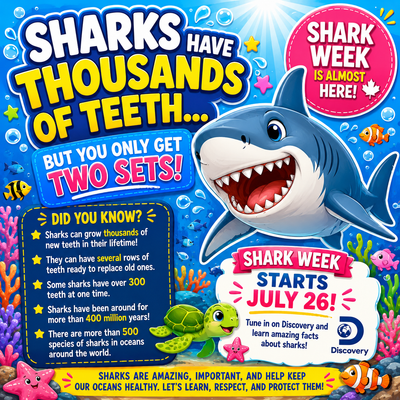
Sharks Have Thousands of Teeth... But You Only Get Two Sets!
Get ready, ocean explorers! Shark Week is coming later this July, and it is the perfect time to learn about one of the most fascinating animals in the sea—sharks!
Every summer, families across Canada enjoy watching shark documentaries, learning fun ocean facts, and discovering why sharks are such important animals. Sharks may look a little scary because of their sharp teeth, but they play a very important role in keeping the ocean healthy.
And speaking of teeth… sharks have some of the most amazing teeth in the animal kingdom!
Unlike people, sharks can lose teeth and grow new ones again and again. If a shark loses a tooth while eating, another tooth moves forward to replace it. Some sharks can grow thousands and thousands of teeth during their lifetime.
People are different. We only get two sets of teeth: our baby teeth and our adult teeth. That means once our adult teeth come in, we need to take very good care of them!
Sharks and Their Super Teeth
Shark teeth are built for survival. Their teeth help them catch food, hold onto prey, and eat in the wild. But not every shark has the same kind of teeth.
Some sharks have long, sharp teeth. Others have flat teeth. Some have teeth that look like tiny needles, while others have teeth shaped like triangles.
The shape of a shark’s teeth depends on what that shark eats.
A shark that eats fish may have sharp, pointy teeth for gripping slippery prey. A shark that eats shellfish may have flatter teeth that help crush hard shells. A Great White Shark has large, serrated teeth that work a little like a steak knife.
That means shark teeth are not just scary-looking—they are perfectly designed for the shark’s job in the ocean.
How Many Teeth Do Sharks Have?
Many sharks have several rows of teeth in their mouths. The front row does most of the work, while the rows behind it wait like backup teeth.
When a front tooth falls out, a new tooth moves forward.
That is why people often say shark teeth work like a conveyor belt.
Some sharks may have hundreds of teeth in their mouth at one time, and some may grow tens of thousands of teeth during their lifetime.
Imagine losing a tooth every time you ate lunch—and then having a new one ready to go!
For sharks, that is completely normal.
How Are Children’s Teeth Different?
Children do not have conveyor-belt teeth like sharks.
Kids usually get 20 baby teeth. These teeth help children chew food, speak clearly, and hold space for adult teeth.
As children grow, baby teeth start to loosen and fall out. This usually begins around age six, though every child is different.
Then the adult teeth begin to come in.
Most adults have 32 permanent teeth, including wisdom teeth. These teeth are meant to last for life.
That is why brushing, flossing, healthy eating, and regular dental visits are so important.
Sharks get replacement teeth all the time.
We do not.
Shark Teeth vs. Human Teeth
|
Sharks |
People |
|
Can grow thousands of teeth |
Get only two sets of teeth |
|
Replace lost teeth again and again |
Adult teeth do not grow back naturally |
|
May have many rows of teeth |
Have one row on top and one row on bottom |
|
Teeth are made for catching food in the wild |
Teeth help us chew, speak, and smile |
|
Do not brush their teeth |
Need to brush twice a day |
|
Can lose teeth often |
Need to protect permanent teeth carefully |
Shark Week in Canada
Shark Week is a fun summer tradition for many Canadian families. It is usually shown on Discovery programming and often includes documentaries, shark experts, ocean footage, and exciting stories about different shark species.
For families in Canada, Shark Week can also be a great chance to talk about the ocean and the amazing animals that live there. Canada has three oceans—the Atlantic, Pacific, and Arctic—which means marine life is a big part of our country’s natural world.
While we may not see tropical sharks swimming around every day, sharks are still part of Canadian waters. Different shark species can be found off Canada’s coasts, especially in the Atlantic and Pacific Oceans.
This makes Shark Week a great opportunity to teach children that sharks are not just movie monsters. They are real animals that help keep ocean ecosystems balanced.
Are There Sharks in Canadian Waters?
Yes! Canada has sharks.
Some sharks live in or travel through Canadian waters. They may be found off the coasts of British Columbia, Atlantic Canada, and other ocean areas.
Some species are large, while others are smaller and less well known. Many people are surprised to learn that sharks can live in colder water, not just warm tropical oceans.
Sharks found in or near Canadian waters may include species such as:
Blue sharks
These sharks are known for their beautiful blue colour and long, slender bodies.
Basking sharks
These gentle giants are huge, but they eat tiny plankton. They swim with their mouths open to filter food from the water.
Porbeagle sharks
These strong swimmers are found in colder waters and are related to Great White Sharks.
Greenland sharks
These mysterious sharks live in very cold northern waters and are known for their extremely long lifespans.
Spiny dogfish
These smaller sharks are found in Canadian waters and are one of the more common shark species.
This can be a fun surprise for kids: sharks are not only found in faraway places—they can be part of Canada’s ocean life too!
Why Sharks Matter
Sharks are important because they help keep oceans healthy.
Many sharks are top predators. That means they help control populations of other animals in the ocean. By doing this, sharks help keep the food chain balanced.
When shark populations become too low, it can affect many other ocean animals too.
That is why scientists study sharks and work to protect them.
Shark Week can be exciting, but it can also help families understand that sharks deserve respect and protection.
They are not villains.
They are an important part of the natural world.
What Can Sharks Teach Us About Teeth?
Sharks remind us that teeth are powerful tools.
They use their teeth to survive in the ocean. We use our teeth every day too!
Our teeth help us:
Chew crunchy fruits and vegetables
Bite into sandwiches
Speak clearly
Smile for photos
Laugh with friends
Keep our jaws healthy
Because teeth do so much for us, they need daily care.
A shark can lose a tooth and grow another one.
But if a person loses an adult tooth, it does not naturally grow back.
That is why your smile needs protection every single day.
How to Care for Your Teeth Like a Smile Superstar
You do not need shark teeth to have a strong smile. You just need good habits!
Brush your teeth twice a day for two minutes.
Use a soft toothbrush and fluoride toothpaste.
Brush all the surfaces of your teeth—the front, the back, and the chewing surfaces.
Do not forget your tongue! Gently brushing your tongue can help keep your breath fresh.
Floss once a day to clean between teeth where your toothbrush cannot reach.
Drink water often, especially after snacks.
Choose tooth-friendly foods like cheese, yogurt, apples, carrots, cucumbers, and leafy greens.
Try to limit sticky candies, gummies, pop, sports drinks, and sugary juice.
Visit your dentist regularly for checkups and cleanings.
These little steps can make a big difference.
Shark Week Family Fun Ideas
Shark Week can be more than watching television. It can become a fun family learning week!
Here are some ideas families can try:
Read a children’s book about sharks.
Draw your own shark and give it a big toothy smile.
Look up where different shark species live.
Make a shark craft with paper fins and googly eyes.
Talk about how sharks help the ocean.
Compare shark teeth with human teeth.
Create a “brush like a shark” bathroom reminder chart.
Pack a beach or cottage dental kit for summer trips.
These simple activities make learning fun and help children connect Shark Week with healthy habits.
Fun Shark Facts for Kids
Sharks do not have bones like people do. Their skeletons are made of cartilage, which is the same flexible material found in your nose and ears.
- Some sharks are very small, while others are enormous.
- The whale shark is the largest fish in the world, but it eats tiny plankton.
- Not all sharks are fast swimmers.
- Some sharks spend time near the ocean floor.
- Sharks have an excellent sense of smell.
- Many sharks have several rows of teeth.
- Shark skin feels rough, almost like sandpaper.
- Some sharks can live in cold water.
- Sharks have been around for millions and millions of years.
There is so much more to sharks than sharp teeth!
When purchasing a Treasure Tower, what forms of payment are accepted?
We accept VISA, Mastercard, and Debit card payments.